
Archive for 2017
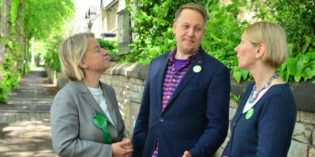
Book review | The Greens in British Politics: Protest, Anti-Austerity and the Divided Left
In The Greens in British Politics: Protest, Anti-Austerity and the Divided Left, James Dennison draws on statistical data as well as interviews with UK Greens to offer an account of the recent evolution of the Green Party of England and Wales and the Scottish Green Party. While the book suffers from some repetition of content and its findings are […]

You Like this and I Like that: is Facebook just an echo chamber, or is something more complicated going on?
Does Facebook create ‘echo chambers’ for its users, or is something more complicated going on? Nick Anspach (York College of Pennsylvania) created mock News Feeds and found that seeing friends endorse and comment on political items made participants 25% more likely to select political news from sources with which they agreed – and 40% more likely […]

Votes at 16: we need a proper conversation about when adulthood begins
The vexed question of whether people should be allowed to vote from the age of 16 has returned to the Commons with Jim McMahon MP’s Private Member’s Bill. Many argue – citing the Scottish independence referendum – that it would provide a democratic stimulus. Yet the evidence for that is lacking, say Andy Mycock (University of […]

Brexit has blown open the unreconciled divisions in Northern Ireland
The British and Irish governments have long tried to keep a lid on the tensions in Northern Ireland. But Brexit, argues Duncan Morrow (Ulster University) has exposed the weaknesses of the Good Friday and St Andrew’s Agreements – deals that never required each side to give up their aims of ruling Northern Ireland alone. Now […]

Understanding Labour’s ingenious campaign strategy on Facebook
The 2017 election saw a stronger than foreseen performance by the Labour Party. Matt Walsh explains how Labour’s Facebook success played out, heralding the party’s overall campaign performance. GE2017 was a numbers game: by achieving very high levels of organic reach, Labour managed to target undecided voters in marginal constituencies, energise voters who had drifted away from the […]

Book review | Against the Grain: A Deep History of the Earliest States
In Against the Grain: A Deep History of the Earliest States, James C Scott contributes to his longstanding intellectual project of re-evaluating the role of the state in political thought by looking at the development of the early agrarian states to challenge narratives of progress founded on state formation. While acknowledging that a number of objections can be […]
Republicans give more to charity – but not because they oppose income redistribution
Who gives more to charity – Republicans or Democrats? Michael Sances (University of Memphis) and Michele Margolis (University of Pennsylvania) found that conservative Americans donate more, even when socio-economic differences are taken into account. Could this be because they support a smaller role for the state, or as an effort to signal their philanthropic credentials? […]

The new prison framework will be inflexible, costly and do nothing to ease chronic overcrowding and violence
The Conservative manifesto planned to create a series of legally enforceable standards that prisons, and those who work with inmates, will have to meet. Nasrul Ismail and Nick de Viggiani (University of the West of England) have interviewed 30 prison policymakers about the proposed new framework. They warn its inflexibility will lead to a ‘compliance […]

What’s driving the decline of the centre-left?
Are centre-left parties across Europe facing terminal decline? Drawing on a new book, Rob Manwaring (Flinders University) and Paul Kennedy (University of Bath) argue that an essential element in any robust democracy is an effective centre-left. However, centre-left parties now face a number of major challenges, from the rise of new parties, to the erosion of their traditional support […]

International election observers: the watchdogs with no bite
Most elections are now monitored by international election observers, whose presence is intended to deter vote-rigging and who report on whether the vote was ‘free and fair’. But after the Kenyan Constitutional Court nullified the recent elections there despite observers having approved them, the value of these missions has been questioned. Sophie Donszelmann (LSE), Cristoforo […]
 Democratic Audit's core funding is provided by the Joseph Rowntree Charitable Trust. Additional funding is provided by the London School of Economics.